Take a Virtual Tour
 Book a Demo

TL;DR: Most organizations are paying twice for threat intelligence. First, they generate the malware telemetry themselves: every file their endpoints touch, every suspicious binary their EDR flags, every artifact their SOC investigates. Then they pay a subscription fee to upload that data to a shared platform, get a verdict, and hand the underlying intelligence to everyone else on the same plan. The economics of that model made sense when there was no alternative. But there is now. Private threat intelligence means owning the corpus you already paid to generate, analyzing it continuously, and keeping the advantage for yourself.
Table of Contents
- The Bill Nobody Audits
- What You’re Actually Contributing
- The Hidden Cost of Point-in-Time
- What Ownership Actually Looks Like
- The Daily-Use Question
- What You’re Leaving on the Table
- Frequently Asked Questions
The Bill Nobody Audits
Every organization running a mature security program is paying for threat intelligence. Most are paying for it in at least three places simultaneously, and the overlap between what they’re getting from each is larger than anyone wants to admit.
There’s the EDR subscription with threat intelligence bundled in. There’s the threat intelligence platform aggregating feeds from multiple sources. And there’s the file reputation and analysis service, the one analysts use for hash lookups and quick file analysis, the one everyone just calls VirusTotal.
Each line item has a renewal conversation. Rarely does anyone ask the harder question underneath all of them: what are we actually getting? What are we giving away to get it? And is the trade still rational?
The crowdsourced model extracts value from your data, returns a fraction of it as shared intelligence, and calls the difference your subscription fee. That exchange made sense at a specific moment in how this industry evolved. The question is whether it still does.
Crowdsourced threat intel? We call that giving away your advantage.
What You’re Actually Contributing
When a security analyst submits a file to a shared reputation platform, the transaction looks simple: hash in, verdict out. The actual exchange is considerably more complex.
The file enters a shared corpus along with metadata about where it came from and when it appeared. That corpus is the product. Other subscribers query it, receive verdicts derived from it, and contribute their own submissions back into it. The platform’s value scales with contributors, which is exactly why the economics work: everyone contributes, everyone benefits, and the platform operator captures the margin in between.
What this means in practice is that the malware artifacts your EDR catches, the suspicious binaries your analysts investigate, the tooling an adversary deployed specifically against your environment, all of it has measurable intelligence value to the platform beyond your subscription fee. You are not just a customer. You are a data supplier.
Your detection timing, your malware artifacts, your investigation activity, those feed the shared corpus. Other subscribers benefit from them. You get a verdict.
This is not a hidden practice. It is the explicit architecture of crowdsourced threat intelligence, and for most organizations the trade is acceptable. For organizations with sophisticated adversaries who actively monitor public platforms for retooling signals, the calculus is different.
Logs are breadcrumbs. Files are truth. And the files your organization generates are some of the most accurate intelligence signals about your specific threat landscape that exist. The current model asks you to contribute that truth to a shared pool and rent back a fraction of what it produces.
The Hidden Cost of Point-in-Time
The subscription fee is only part of the real cost. The larger cost shows up in analyst time, investigation gaps, and missed detections, and it never appears on an invoice.
Point-in-time analysis produces a verdict at the moment of submission and nothing after. If new intelligence emerges next month that recontextualizes that file, new campaign attribution, a newly documented TTP cluster, a malware family connection that wasn’t visible before, that connection is never made automatically.
The analyst who ran the original lookup has moved on. The file sits in your environment, unlinked from the investigation that could have used it, while the intelligence landscape around it quietly changes.
Incident response investigations reveal this gap constantly. Malware artifacts were present in the environment months before detection. Earlier samples were submitted to reputation services and returned no result. The connection between those earlier files and the eventual incident existed, but it never surfaced because nobody was continuously looking.
The retroactive forensic work that follows, tracing campaign lineage backward through file history, is expensive, slow, and avoidable.
We call the alternative continuous hindsight. Every file in your environment, preserved and continuously reanalyzed as new intelligence emerges. The binary your EDR flagged three months ago stays alive in your corpus. When a threat research team publishes new campaign attribution, when a published IOC matches something in your Private Vault, that connection surfaces automatically. Not because someone searched for it, but because the analysis never stopped. Hindsight in real time, without the manual work.
Continuous reanalysis also unlocks something point-in-time tools can never give you: prevalence as a signal. How many times does a file appear across your environment? A file present on 5,000 machines is almost certainly notepad.exe. A file present on exactly one machine, especially if that machine belongs to your CFO, is an entirely different conversation. Low prevalence is an anomaly. Anomalies deserve investigation. A corpus that has only ever seen your files from today cannot tell you that. A private vault that has captured every file from every endpoint across years of history can tell you immediately.
Cross-environment prevalence matters too. If the same file appears across 100 organizations, it’s probably a common system binary or a commodity tool. If it exists only inside your environment, on a single endpoint, the threat model shifts. You are no longer looking at broad-based malware. You may be looking at something purpose-built for you.
That distinction is invisible to a public platform. It is foundational in a private one.
What Ownership Actually Looks Like
The alternative to renting shared intelligence is owning a private corpus. The distinction is architectural, not cosmetic.
Stairwell flips the model.
Your files go into a Private Vault, not a shared corpus. Your telemetry is analyzed in your environment. The intelligence derived from that analysis belongs to your organization. Your detection timing is not visible to platform operators or other subscribers. Your malware artifacts are not feeding someone else’s corpus. And critically, the value of those files does not expire when the initial analysis completes.
| Shared Intelligence Model | Stairwell Model |
|---|---|
| Crowdsourced corpus | Private Vault |
| Public sample uploads | Private analysis |
| Point-in-time verdicts | Continuous hindsight |
| Shared visibility | Owned visibility |
| Verdicts | Understanding |
Shared platforms can tell you what the crowd has seen. A private corpus tells you what your environment has seen, across every file it has ever processed, continuously. For a targeted organization dealing with adversaries who know how to operate below the detection threshold of public platforms, those are different questions entirely. Only one of them is the right one to be asking.
The Daily-Use Question
Crowdsourced file reputation services score well on daily use because the lookup workflow is fast and the results are immediate. Analysts use them reflexively, the way they check email.
The problem is that reflexive use of a point-in-time tool creates a false floor under investigation quality. An analyst who runs a hash lookup, gets no result, and moves on has not established that a file is benign. They’ve established that the crowd hasn’t seen it.
For commodity malware, those two conclusions often align. For targeted tooling, custom implants, or hash-modified variants built for a single operation, they are entirely different, and conflating them is how targeted incidents get missed.
A threat intelligence environment that delivers genuine daily-use value works differently. It makes intelligence available to the analyst without requiring the analyst to know what to look for. When an EDR alert fires and an analyst opens an investigation, the relevant file context, lineage, structural relationships, behavioral analysis, should already be there. Not because an analyst queried a reputation service, but because the analysis has been running continuously since the file first appeared.
Part of that context is prevalence. Before an analyst spends an hour triaging a file, they should know: how many times have we seen this in our environment? Is it on one machine or a thousand? Is it concentrated in one team, one location, one role? A file with enterprise-wide distribution across common system paths reads very differently from a file that has appeared once, on the laptop of a specific high-value target, at 2 AM. Prevalence does not replace analysis. It directs it. Analysts can prioritize the right files instead of treating every unknown hash as equally worthy of attention.
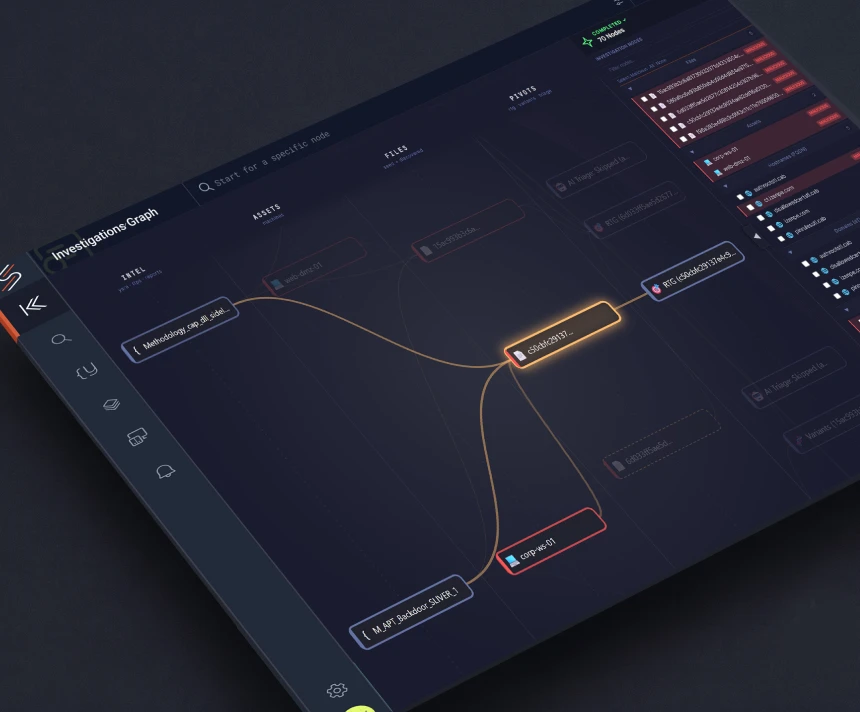
Stairwell’s AI Triage steps outside the sandbox. It doesn’t pretend to detonate malware. It reads it. Structured AI reasoning explains what the malware does, how it works, and why it exists. Not just a verdict. Understanding.
That analysis exists for every file in your Private Vault, not just the ones an analyst thought to query. Stairwell’s Variant Discovery surfaces files that share structural DNA with confirmed threats, regardless of hash or signature, giving analysts visibility across entire malware families from a single confirmed bad file. Stairwell’s Run to Ground turns one investigation into full campaign visibility: related files, affected hosts, associated infrastructure, mapped across your organization’s entire file history in seconds, from data that never left your environment.
We don’t only show verdicts. We show file and threat intelligence understanding.
What You’re Leaving on the Table
The ROI calculation for threat intelligence tools rarely accounts for the cost of what the current model fails to produce. Missed variant detection, incomplete incident scope, and retroactive investigation work are real costs.
They show up in incident response spend, in extended dwell time, in senior analyst hours consumed by forensic reconstruction that a private continuous corpus would have surfaced automatically. Those costs don’t appear on the threat intelligence invoice. They appear everywhere else.
The right comparison is not the subscription fee for a shared reputation service against the cost of a private intelligence environment. It’s the total cost of operating with point-in-time intelligence. Verdicts that expire, variants that evade, incidents that take weeks to scope because file history was never preserved, against the compounding value of continuous detections in an environment where every file you’ve ever seen stays alive, continuously reanalyzed, ready to surface connections the moment new intelligence makes them visible.
Security is a data problem. Files are the source of truth. The organizations that preserve that truth, analyze it continuously, and keep the resulting intelligence private are not spending more on threat intelligence. They are spending it on a model that gets more valuable over time rather than resetting at every renewal.
That is not a cost center. That is an intelligence program.
Frequently Asked Questions
What is the difference between private threat intelligence and crowdsourced threat intelligence?
Crowdsourced threat intelligence aggregates file submissions, verdicts, and indicators from thousands of organizations into a shared corpus. When you submit a file, you receive intelligence derived from what the crowd has collectively seen, and your submission contributes to what others can see.
Private threat intelligence inverts that model. Your files go into an environment you control, analyzed against your own telemetry and a curated malware corpus, with no visibility into your detection activity from outside your organization.
The practical difference is significant: crowdsourced platforms tell you what the crowd has seen, while a private corpus tells you what your environment has seen, continuously, over time, without exposing your data or detection posture to anyone else.
Why does point-in-time malware analysis create gaps in threat detection?
Point-in-time analysis produces a verdict at the moment of submission. If a file returns no result, the interaction ends there. But the intelligence landscape around that file doesn’t stop changing. New campaign attribution gets published. New malware families get documented. New IOCs get correlated.
In a point-in-time model, none of that new intelligence is automatically applied to files you’ve already analyzed. A binary that looked clean three months ago may connect clearly to a known threat actor today, but nobody made that connection because the analysis stopped when the original verdict was issued.
Continuous reanalysis means every file you’ve ever collected stays active in your corpus, and new intelligence surfaces retroactive connections automatically, without requiring an analyst to know what to look for.
What is file prevalence, and why does it matter for threat detection?
Prevalence is how many times a file appears across your environment and relative to what’s been seen elsewhere.
A file present on 5,000 machines across your enterprise is probably a known system binary. A file present on exactly one machine is an anomaly, and anomalies demand attention. If that single-instance file sits on the laptop of a high-value target, a C-suite executive, a finance lead, someone with elevated access, the threat model shifts significantly. You may be looking at something purpose-built for your organization rather than off-the-shelf malware.
Cross-environment prevalence adds another dimension. A file that appears across hundreds of other organizations reads differently from a file your environment has never seen and that has no known presence anywhere else. Low prevalence is a signal. It is not a verdict, but it is a priority signal, one that tells analysts which files to investigate first rather than treating every unknown hash as equally suspicious.
This kind of signal requires a corpus that has captured every file from every endpoint over time. A public platform that only receives what you choose to upload cannot tell you that. A private vault built on your environment’s complete file history can tell you immediately.
Does submitting malware samples to shared platforms create real operational risk?
Yes, in specific threat models it does. Sophisticated threat actors actively monitor public malware analysis platforms to understand which of their tooling has been detected. A submission from your environment tells platform operators, and in some architectures other subscribers, that your organization encountered a specific artifact at a specific time.
Operators of targeted intrusion campaigns use that signal to assess when variants need to be redeployed. They submit modified versions of their own tooling to observe which detection engines respond. For organizations dealing with advanced persistent threats or state-sponsored actors, submitting samples to shared platforms feeds an adversarial feedback loop that works directly against your detection posture.
What does “continuous hindsight” actually mean in a SOC workflow?
Continuous hindsight means that every file your organization has ever collected is preserved and reanalyzed as new intelligence emerges, automatically, without analyst intervention.
In a practical SOC workflow, this changes the starting position of every investigation. When an EDR alert fires, an analyst doesn’t run a hash lookup and wait for a result from a shared reputation service. The relevant context, what the file does, what it’s related to, whether structurally similar files have appeared elsewhere in your environment, how prevalent it is across your endpoint population, is already assembled.
When threat research surfaces new campaign intelligence, it’s automatically cross-referenced against your Private Vault. Connections that would have taken days of retroactive forensic work surface in seconds. The investigation starts ahead, not from zero.
How does Variant Discovery improve on signature-based malware detection?
Signature-based detection identifies files that match a known pattern, typically a hash or a specific byte sequence. It works well for commodity malware that appears in identical form across many environments. It fails for targeted campaigns, where adversaries routinely modify tooling before deployment specifically to defeat signature matching.
Variant Discovery identifies structural relationships between files, shared code, similar behavioral patterns, overlapping infrastructure, regardless of hash or signature. A single confirmed bad file becomes the starting point for visibility across the entire malware family, including variants your environment has seen that were never submitted to any public platform and carry no public detection.
What is the ROI case for private threat intelligence compared to shared reputation services?
The direct cost comparison understates what the current model actually costs. The real cost of operating with point-in-time, shared intelligence includes retroactive investigation work when verdicts prove incomplete, extended dwell time when targeted variants evade public detection, senior analyst hours spent reconstructing file history that a private corpus would have preserved automatically, and the ongoing contribution of your organization’s malware telemetry to a corpus that benefits your adversaries as much as it benefits you.
Private continuous intelligence compounds in value over time. Every file collected enriches the corpus. Every new IOC published is cross-referenced automatically. Prevalence data becomes richer with every endpoint, every day. The intelligence environment gets more capable the longer it runs, not reset with every renewal cycle.
Imagine your own VirusTotal, the way it should have evolved.
Stairwell: Private by design. Continuous by default. The way threat intelligence should have evolved.