Take a Virtual Tour
 Book a Demo

Abstract
- YARA rules are reusable detection logic that match files against analyst-defined patterns and conditions, helping security teams identify and investigate related evidence beyond exact hashes.
- Effective rules depend on distinctive, stable characteristics, precise conditions, and testing against both expected matches and benign files.
- YARA supports malware classification, threat hunting, incident scoping, threat intelligence, and retro-hunting, but a match is evidence to investigate, not a malicious verdict.
- At scale, detection quality also depends on the file corpus, retained historical evidence, and enough context to interpret matches as threats evolve.
When analysts identify a malicious file, a hash can help them find that exact file again. But attackers rarely make life that easy. Change the file, even slightly, and the hash changes with it. YARA lets defenders look beyond exact matches by describing the characteristics that matter and turning those observations into reusable detection logic.
But writing a valid rule is only the beginning. A 2026 study of more than 6,000 malware and benign samples found that even technically sound public YARA rules could produce significant false-positive noise and low recall. So what does effective YARA detection depend on?
What are YARA rules and how do they work?
YARA is a pattern-matching language widely used by malware researchers, threat hunters, incident responders, and detection engineers. A rule describes characteristics to look for and uses a condition to determine whether the scanned data satisfies the rule.
Unlike an exact hash, a YARA rule can match multiple files that share the characteristics it describes. YARA itself doesn’t determine whether files are similar or related; it evaluates whether each file satisfies the rule’s defined logic.
A YARA rule has four main parts: a rule identifier, optional metadata, strings or patterns, and a required condition. The metadata can document the rule’s purpose, author, date, malware family, or reference. The strings section defines the characteristics to search for, while the condition expresses the logic that determines a match.
For example:
rule Example_Downloader
{
meta:
description = “Example rule for a Windows downloader”
strings:
$config = “example_config_v2”
$mutex = “Global\\example_mutex”
$code = { 8B 45 FC 33 D2 F7 75 F8 }
condition:
uint16(0) == 0x5A4D and
filesize < 2MB and
2 of them
}
- The rule identifier is Example_Downloader. Its metadata explains the rule’s purpose but does not determine whether it matches.
- The strings section contains two text patterns and one hexadecimal byte pattern.
- The condition checks for the MZ signature at the start of the file, limits the file to under 2 MB, and requires at least two of the three patterns to match.
These constructs are supported by current YARA syntax: uint16(0) == 0x5A4D is the documented test for an MZ signature, filesize is a built-in keyword, and of can require a specified number of defined strings to match.
YARA’s main pattern types are text strings, hexadecimal byte patterns, and regular expressions. Text patterns can also use modifiers such as ascii, wide, and nocase. The right pattern type depends on what characteristic the analyst is trying to encode.
Most importantly, a YARA match means that the scanned data satisfied the rule’s condition. It is evidence to investigate, not automatically a malicious verdict.
What about YARA-X?
YARA-X is a newer YARA implementation developed by VirusTotal that focuses on performance, safety, and usability. YARA-X 1.0 became stable in June 2025, when the original YARA entered maintenance mode. YARA-X aims for high rule-level compatibility, and most YARA rules work unchanged, although documented differences remain.
For teams maintaining existing rule sets, that means you don’t need to treat YARA and YARA-X as entirely different rule languages. But you should still check rules against the engine and environment where they will actually run.
What are YARA rules used for?
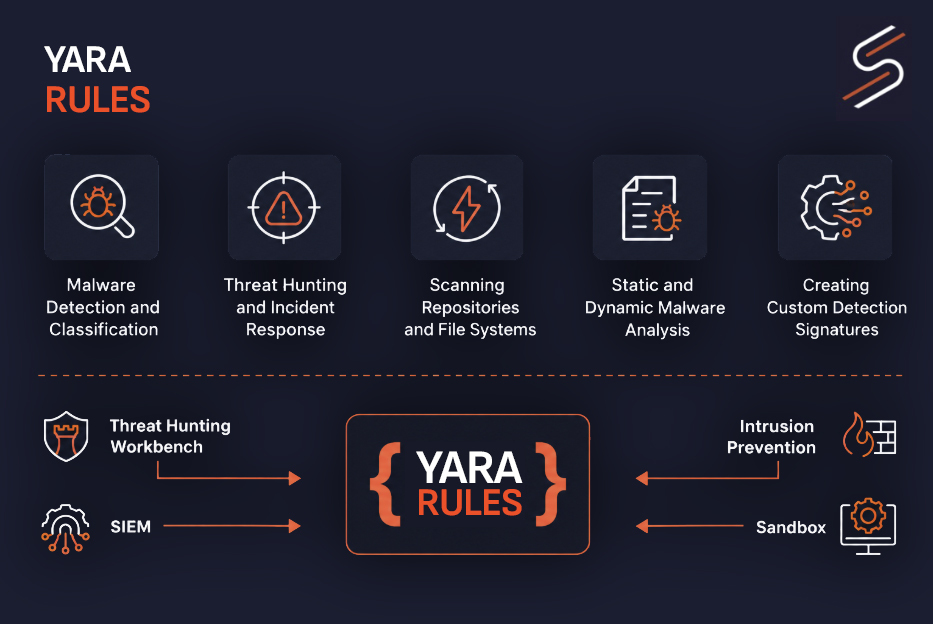
YARA is useful for more than identifying a single known malware sample. Because rules turn analyst knowledge into reusable detection logic, they can support several security workflows:
- Malware identification and classification: Encode durable characteristics associated with a malware family or group of samples rather than relying exclusively on exact hashes.
- Threat hunting: Search files for characteristics associated with current intelligence, a campaign, or an investigation, including threats that may have bypassed perimeter security controls.
- Incident response and scoping: Turn what analysts learn from a suspicious sample into a rule, then search for additional files that match the same logic.
- Threat intelligence operationalization: Convert malware research, published intelligence, or internal findings into portable, machine-readable detection logic.
- File labeling and context: Describe non-malicious characteristics such as file types, packers, macros, or other features that help analysts classify files and pivot during investigations.
- Historical or retro-hunting: Where historical files have been retained, apply newly created or received rules to earlier evidence to look for prior sightings. A new YARA rule can also support retro-hunting, but only if the relevant historical files are still available to search.
How to write a YARA rule
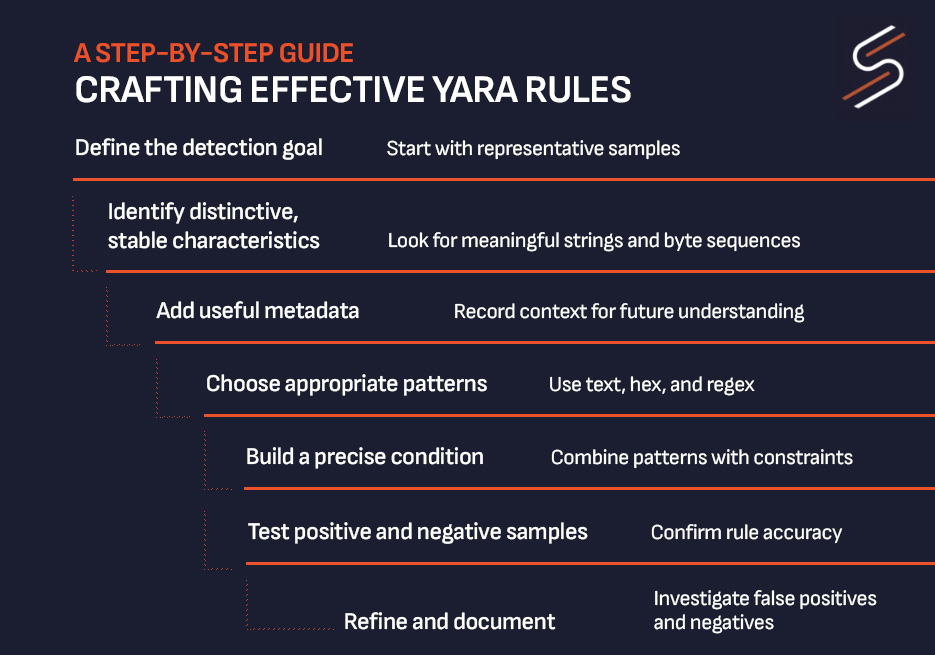
- Define the detection goal. Start with representative samples and establish what the rule should and should not match. A rule designed to identify a specific ransomware family, for example, has different requirements from a broader exploratory hunting rule.
- Identify distinctive, stable characteristics. Look for meaningful strings, byte sequences, structural traits, or other characteristics that persist across the samples of interest. Avoid generic content likely to occur in unrelated files.
- Add useful metadata. Record enough context for another analyst to understand the rule later: its purpose, author, date, family or campaign, and relevant references. Metadata does not affect matching, but it makes rules easier to understand and maintain.
- Choose appropriate patterns. Use text for distinctive readable strings, hex patterns for byte sequences, and regular expressions when genuine variability requires them. Avoid complexity that does not improve the detection logic.
- Build a precise condition. Combine patterns with useful constraints. File type, file size, offsets, occurrence counts, and combinations of patterns can turn a generic search into a narrower detection claim.
- Test positive and negative samples. Confirm that the rule matches representative files it should detect and does not match files it should exclude. Syntax validation alone is not enough. Stairwell’s current guidance also recommends testing against files with a known expected answer before saving a rule.
- Refine and document. Investigate false positives and false negatives. As malware, software, and threat intelligence change, you may need to tighten, broaden, replace, or retire rules.
YARA rules: best practices and common mistakes
1. Use distinctive, sufficiently long patterns
Choose patterns that are unlikely to occur by chance and that persist across the samples you want to detect. Instead of a common API name such as CreateProcessW, which may appear in legitimate software, look across several samples for a longer, malware-specific configuration string that remains consistent across variants.
For byte patterns, prefer a longer sequence from a distinctive routine over a short sequence of common instructions. Avoid distinctive but unstable indicators, such as a unique filename or build-specific value.
2. Combine signals and meaningful constraints
Don’t trigger a rule because one string appears. If your analysis shows that the target samples consistently contain a particular configuration string and a distinctive byte sequence, require both – or require two of several known indicators.
Then add constraints only when they describe a real property of the target. Don’t copy a file size or offset from one sample just to reduce false positives. A later variant may be larger or place the same content elsewhere, causing the rule to miss it.
3. Use regex deliberately
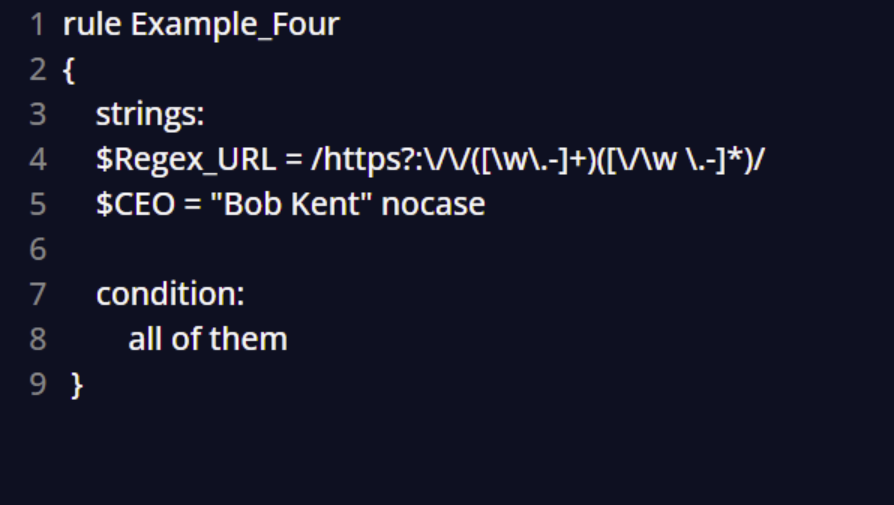
Use regex when an indicator varies between samples but follows a predictable pattern. For example, if a configuration string has a fixed prefix followed by changing digits, regex can capture that variation. If the value is constant, use a text or hex pattern instead.
Keep expressions narrow and anchor variable portions with known content where possible. Avoid broad patterns such as .* when a more specific expression will work; they can create unintended matches and become expensive when rules run continuously or across large file collections.
4. Test positive and negative samples
Test against multiple variants that should match, not just the samples used to create the rule. Then test against benign and unrelated files that should not match, particularly files with similar characteristics.
This test exposes the precision-versus-coverage trade-off: make a rule too broad, and analysts spend time investigating noise; tune it too closely to known samples, and it may miss meaningful variants.
5. Revisit rules as intelligence changes
Use clear naming, metadata, comments, and references so the rule’s purpose and assumptions remain understandable. Use new samples and matches as feedback. Repeated false positives may expose a weak indicator, while missed variants may reveal an overly restrictive condition. Tune, replace, or retire rules as that evidence changes.
A YARA match is evidence, not a standalone malicious verdict. In Stairwell, analysts can investigate matches alongside prevalence, similarity, historical observations, and threat intelligence to understand their significance.
How to use YARA rules at scale
Writing a YARA rule is only part of the job. To operationalize YARA at scale, teams need the right files to search, a consistent way to apply rules, enough history to look backward, and context to understand what a match means.
1. Search the right file corpus
The corpus determines what YARA can tell you. Public malware collections support research and rule development, while endpoint scanning can support targeted hunts and incident response. Retained first-party files answer a different – and organization-specific – question: has evidence matching this rule appeared in our environment? As with other security data, organizations should apply least privilege when determining who can access and search that evidence.
2. Apply new knowledge to historical evidence
A YARA rule created from intelligence published today can detect future files, but searching only new arrivals leaves a blind spot: matching files may already have appeared weeks or months earlier. This can be particularly important in a software supply chain compromise, where affected files may have entered the environment before the threat was identified.
Stairwell preserves first-party executable file evidence from the customer environment. New YARA rules can therefore apply to files the platform already holds, as well as new arrivals, including evidence that may not have triggered an alert when it first appeared. The same rule can therefore search historical evidence and evaluate new files as they arrive.
3. Investigate matches in context
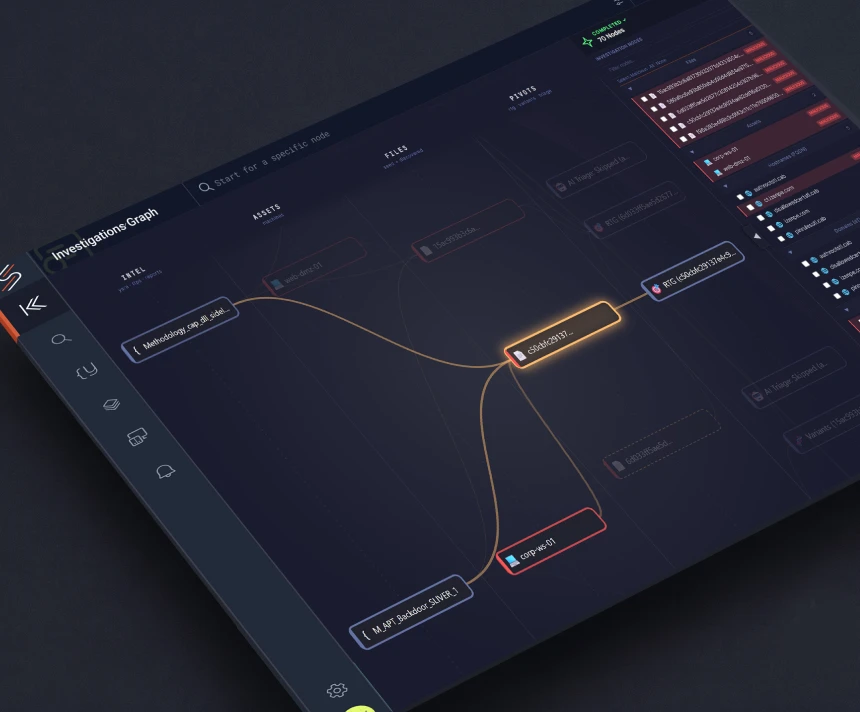
Finding a match starts the investigation. In Stairwell, analysts can examine matched files alongside prevalence, similarity, historical observations, affected assets, and threat intelligence to understand their significance and identify related evidence. AI Triage can then provide an analyst-grade assessment of the file, including malicious likelihood, IOCs, and MITRE mapping.
Because the underlying file evidence is retained, analysts can repeat the process as knowledge changes to provide continuous hindsight. New YARA rules, IOCs, detections, or threat intelligence can be applied to historical evidence, not only files arriving from that point forward.
Make YARA knowledge reusable
YARA gives security teams a portable way to turn file knowledge into detection logic they can apply repeatedly. But strong results depend on more than valid syntax: rules need distinctive characteristics, precise conditions, representative testing, ongoing maintenance, and access to the right files, including historical evidence when teams need to look backward.
Stairwell extends that model with retained first-party file evidence from the customer environment. New YARA rules and threat intelligence can be applied to that history as knowledge changes, while matches can be investigated alongside other file-level evidence.
See how Stairwell applies YARA rules and new threat intelligence to retained evidence across your environment. Request a demo.