Take a Virtual Tour
 Book a Demo

TL;DR: When security teams say “private VirusTotal,” they usually mean the VirusTotal-style workflow. Fast hash lookups, file analysis, and threat context, without public sample sharing. Privacy is the baseline, but it is not the whole story. A true next generation enterprise private malware intelligence platform also preserves every file you have seen, continuously reanalyzes it as intelligence changes, finds variants beyond hash matches, and enables retroactive hunting like YARA across your full historical corpus. All of this happens while keeping your artifacts under your control.
Table of Contents
- What People Mean When They Say “Private VirusTotal”
- Why the Public Model Creates Problems for Enterprises
- Privacy Is the Starting Point, Not the Finish Line
- How a Next Generation Private Malware Intelligence Platform Actually Works
- What Changes When You Own Your Intelligence
- Where This Fits in an Enterprise Security Stack
- Frequently Asked Questions
- The Bigger Picture of Connected Threat Intelligence
What People Mean When They Say “Private VirusTotal”
“Private VirusTotal” is not a product name. It is a shorthand for a gap of “Private Malware Analysis”.
VirusTotal is useful. You can submit a hash or upload a file and quickly see whether it has been observed, what engines flag, and what context exists. That workflow is second nature for many SOC and IR teams. VirusTotal also offers enterprise capabilities and privacy-preserving options, including Private Scanning, for cases where sharing artifacts is not acceptable.
So why do teams still ask for a “private VirusTotal”?
Because what most enterprise teams want is not just a private upload option. They want a platform where their files remain theirs, stored privately and retained as long as they need. They want analysis that improves over time as intelligence changes. They want to answer questions like these:
- Have we ever seen anything like this before?
- Where else did it land?
- What variants are hiding in our file history?
That requires more than a privacy setting. It requires a different model.
Why the Public Model of Malware Analysis Creates Problems for Enterprises
The public sharing model is a feature for the broader security community. It is also the reason many enterprises have to be careful about how they use it.
Adversary awareness. Publicly shared samples can act as a signal. Attackers may monitor public repositories to understand when their payloads are detected or studied.
Policy and regulatory constraints. Many organizations restrict or prohibit uploading incident artifacts to public services. Once a file leaves your environment, you lose control over how it is stored, accessed, and redistributed.
Operational exposure. Incident artifacts can contain embedded details about your environment. Hostnames, configuration fragments, and infrastructure hints can unintentionally travel with the sample.
These concerns are why security teams ask for the same speed and utility, paired with enterprise-grade control.
Privacy Is the Starting Point, Not the Finish Line
A common misconception is that a “private VirusTotal” just means VirusTotal-style analysis without public sharing.
Privacy matters, but point-in-time analysis is not enough.
Threat intelligence evolves continuously. A file that looked benign months ago may match a newly published rule today. Detection logic improves. Malware families get reclassified. If your platform only analyzes files at upload time, your conclusions age quickly.
A true private malware intelligence platform should do three things:
- Keep your artifacts private by design. No contribution to public repositories. No cross-tenant sharing by default.
- Continuously reanalyze your corpus. Every file you have collected benefits from new intelligence automatically.
- Go deeper than verdicts. Provide context about what the file does, how it behaves, and how it connects to threats and to your environment.
That is the difference between a private submission workflow and owned intelligence.
How a Next Generation Private Malware Intelligence Platform Actually Works
Here is what this looks like in practice, using Stairwell as the reference architecture.
1) A private vault that preserves your file history
Stairwell is designed to give security teams visibility into every file across their environment, past and present, by collecting and storing files in a private vault and analyzing them at ingestion. The practical outcome is that you are no longer limited to what you can see right now. You have a durable corpus you can investigate and hunt across.
2) Continuous reanalysis
Stairwell’s model is continuous by default. As detection logic, intelligence, and analysis models update, previously collected files are automatically revisited, so your historical inventory does not go stale.
3) Structured AI reasoning for triage
Enterprise triage fails when tools return only a verdict. In addition, Stairwell provides structured, explainable analysis to help analysts quickly understand what a file does and why it matters, rather than forcing a binary decision without the story behind it.
4) Variant discovery beyond hash lookups
Hash-based workflows are fast, but brittle. Attackers recompile, repack, and modify tools constantly. Stairwell is built to surface structurally similar files across your environment so you can find variants even when hashes differ.
5) Retroactive YARA at scale
YARA is foundational to threat hunting, but many environments struggle to run rules retroactively across large historical corpora quickly. Stairwell makes YARA practical at scale by continuously applying rules across your enterprise file history so new matches surface as intelligence changes.
6) Investigation workflows that help you run it to ground
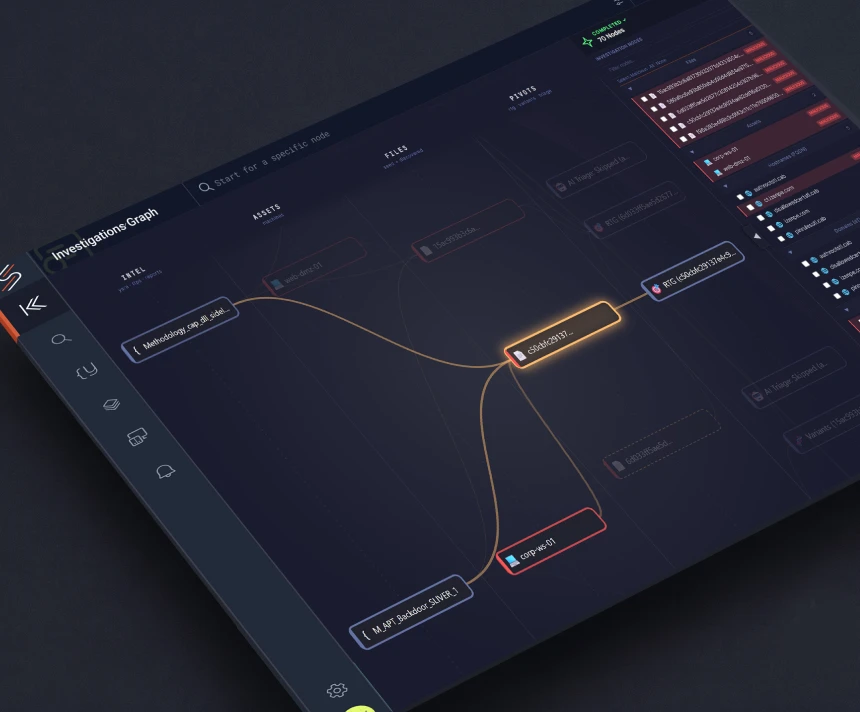
Enterprise investigations require more than a label. Stairwell supports investigative pivots that help you scope prevalence, identify related files, and drive incidents toward containment with confidence.
Privacy is the foundation. Continuous intelligence is the engine. Investigation depth is what makes the output operational threat intelligence.
What Changes When You Own Your Intelligence
When you move from “lookup and move on” to “preserve and reanalyze,” three things change.
Hindsight becomes a capability. With a living file history, you can ask whether a threat was present before it was widely understood or whether related variants appeared earlier in your environment.
Containment becomes provable. Incident response ends when you can show that related files, variants, and indicators are not present elsewhere, now or historically. A private, continuously analyzed corpus makes that proof possible.
Hunting becomes operational. When YARA and similarity pivots are fast and retroactive, hunting becomes part of daily workflow.
Your artifacts stay yours. You can still consume external intelligence and research. You simply do not have to trade your incident files to get analysis capability.
Where This Fits in an Enterprise Security Stack
A private malware intelligence platform complements your existing stack. It does not replace EDR, SIEM, or threat intel feeds.
- EDR tells you something happened on an endpoint.
- SIEM correlates events across the environment.
- Threat intel feeds tell you what is happening in the broader landscape.
- A next generation private malware intelligence platform tells you what the file is, what it does, whether you have seen related variants, and how far it reaches across your history, without exposing your artifacts.
It is the layer that turns detection into understanding and suspicion into confidence.
Frequently Asked Questions
What exactly is a “private VirusTotal”?
It usually means VirusTotal-style file analysis and threat lookup without public sample sharing, plus enterprise-grade control over retention, access, and visibility.
Is it accurate to say VirusTotal is public by design?
The widely used community workflow is based on a shared corpus, or crowdsourced files. VirusTotal also offers enterprise and privacy-preserving offerings like Private Scanning for cases where broad sharing is not acceptable, but these require additional fees to use.
How is this different from simply avoiding VirusTotal uploads?
Not uploading avoids exposure, but it also removes speed and context. A private platform gives you back the workflow, including hash lookup, file analysis, hunting, and pivots, without making disclosure the default.
Is this just a private sandbox?
No. Sandboxes focus on detonation and behavioral capture. A private malware intelligence platform preserves a corpus, continuously reanalyzes, supports retroactive hunting like YARA, and enables variant discovery and investigative pivots across your file history.
Does a private platform still use external intelligence?
Yes. Privacy applies to your artifacts. You can still benefit from external research, detection rules, and threat intelligence data without exposing your incident files.
Can I still collaborate with external researchers?
Yes. You choose what to share and when. The difference is that sharing becomes a deliberate decision, not a side effect of the platform.
The Bigger Picture of Connected Threat Intelligence
The idea behind “private VirusTotal” is simple. Security teams want fast, reliable file analysis without giving up control of their artifacts.
What is hard is delivering that at enterprise scale, where privacy is the baseline and continuous intelligence is the requirement.
The real value comes after privacy. It comes from having a living record of every file your organization has encountered, continuously analyzed, instantly searchable, and under your control.
Private by design. Continuous by default. Yours to keep.
That is not a feature. That is what threat intelligence should have evolved into.