Take a Virtual Tour
 Book a Demo

TL;DR: VirusTotal is useful for quick hash lookups, but uploading malware samples to a public platform creates real risks for enterprises. Attackers can monitor public repositories to learn when their malware has been detected, and many organizations prohibit uploads to VirusTotal as a matter of policy. A private alternative like Stairwell gives security teams the same fast triage and deep file analysis without exposing samples publicly, while adding continuous reanalysis, variant discovery, and retroactive YARA across your entire file history and connecting the collected cyber threat intelligence to your environment.
Table of Contents
- Why Enterprises Are Reconsidering VirusTotal
- Where Public Malware Analysis Falls Short
- What a Private VirusTotal Alternative Looks Like
- Moving From One Time Scans to Continuous Intelligence
- From Verdicts to Understanding: AI Triage Without Detonation
- Variant Discovery: Find What Looks Like It
- Run to Ground: Turn a Hash Into a Campaign
- YARA at Ludicrous Speed: Retroactive Forever
- Frequently Asked Questions
- The Enterprise Shift in Cyber Threat Intelligence
Why Enterprises Are Reconsidering VirusTotal
For many security teams, using VirusTotal is muscle memory. An alert fires in your EDR, someone copies the hash, and within seconds you know whether it has been seen before. It is fast, familiar, and useful.
But in large organizations, that workflow comes with a question that smaller teams do not always have to think about.
Looking up a hash is one use case, but what happens to the file after you upload it?
Many enterprises are prohibited from uploading files to VirusTotal because of the public sharing nature of the upload. Once uploaded the file is available for the rest of the world. If a bad actor is targeting your organization they can use VirusTotal to check whether their deployed malware has ever been detected, effectively tipping them off that your organization is aware of the intrusion. Beyond the operational risk, many organizations treat uploading to VirusTotal as a policy violation that can result in disciplinary action.
That tension is why more teams are searching for a VirusTotal alternative for enterprises. They are not trying to replace fast triage. They are trying to keep it without giving up control. In a public ecosystem, your detection becomes their early warning system.
And for most enterprise SOCs, the real pain is not “was this malicious today?” It is hindsight.
- Was this file present before it was known?
- Did it show up anywhere else?
- Did we actually contain it, or did we just stop seeing alerts?
Knowing that the file is malicious versus knowing was this file ever in your environment are very different in terms of outcomes. It is the difference between detection and confidence. In incident response, confidence of knowing what happened and the impact on your environment is what you brief and report. And ultimately it is what you get audited on.
Where Public Malware Analysis Falls Short
Public malware analysis platforms are built on sharing. Files are uploaded, scanned, and added to a broader dataset that benefits the community. That shared visibility has value.
The issue is that enterprise security is not just about detection. It is also about ownership and risk management.
Imagine investigating a suspicious executable found on an endpoint. Or analyzing a script that was dropped during an intrusion. Or triaging a malware sample that contains callbacks to your internal infrastructure or callouts to external command and control infrastructure. Uploading those files to a public platform does not just expose the sample. It tells the adversary you found it. And in many enterprises, that upload itself violates internal security policy.
When security leaders ask for a private VirusTotal, what they are really asking for is a way to perform malware analysis without public uploads. They want the insight without the exposure.
But there is a second issue that matters just as much: the crowdsourced model.
VirusTotal and similar platforms work because samples enter a shared pool. That is the reciprocal deal. Your upload helps everyone else, and the corpus grows.
Enterprises do not always want that deal.
Crowdsourced intel is powerful but It is also a leakage path. Crowdsourced intel is community defense but it is also community visibility.
And in many environments, “community visibility” is just a nicer way of saying “we gave away our advantage.”
What a Private VirusTotal Alternative Looks Like
A true enterprise alternative maintains the familiar workflow for analysts.
You can still look up a hash. You can still upload a file for deeper inspection. You can still use it as a second opinion during SOC triage.
The difference is in where the file lives.
Instead of entering a shared ecosystem, the file stays in a dedicated environment that belongs to your organization. It is not redistributed to other tenants. It does not become part of a public repository.
Stairwell is built around this idea with its Private Vault model. Files and artifacts remain isolated to the customer’s tenant. They are analyzed, stored, and searchable, but never shared.
That shift sounds like privacy. It is bigger than privacy.
It changes the foundation from borrowed visibility to owned intelligence.
Instead of relying on someone else’s corpus, you build a living corpus of your own environment:
- Every file your enterprise has ever seen
- Searchable on demand
- Continuously reanalyzed as intelligence evolves
- Kept private by design
That is what a true private VirusTotal for enterprises should mean.
Privacy alone is not enough, though. Enterprises also need depth.
A real VirusTotal replacement for the enterprise should explain what a file does, how it behaves, and how it connects to known malware families or variants. It should help an analyst move from a simple detection question to a clearer understanding of risk.
Beyond verdicts it should help with understanding and provide context.
Moving From One Time Scans to Continuous Intelligence
Traditional malware analysis often happens once. A file is uploaded. A result is recorded. The investigation moves on.
The problem is that threat intelligence keeps changing. New indicators of compromise are published every day. Malware families are renamed or regrouped. Detection logic improves. A file that looked harmless a month ago may look very different in light of new information.
Enterprises need a platform that does not treat analysis as a one time event.
Files should be revisited automatically as intelligence evolves. Historical artifacts should be searchable against new rules. Old investigations should benefit from new context.
This shift turns malware analysis into something ongoing. It supports both reactive triage and proactive threat hunting.
Instead of asking only whether a file is malicious right now, teams can ask:
- Was this here last quarter, before anyone had a name for it?
- Is it related to anything else we have seen before?
- Did it evolve, or did we miss a variant?
That is what continuous malware intelligence looks like. The result is continuous hindsight in real time.
From Verdicts to Understanding: AI Triage Without Detonation
Most teams have enough verdicts, but what they do not have is time.
When a file triggers an alert, the first question is not “what label does it get?” The first question is “what does it do?”
A private VirusTotal alternative should not stop at “malicious” or “suspicious.” It should explain behavior, context, and intent.
This is where Stairwell’s AI Triage matters.
It doesn’t pretend to detonate malware. It reads it. It produces structured reasoning from static and behavioral signals without needing a sandbox run for every question. Think of it as a sandbox-lite.
That changes triage from “wait for detonation output” to “understand immediately.” It doesn’t completely eliminate sandboxing, but it certainly reduces the volume of sandbox detonations required. If AI Triage indicates what the file does in seconds, it is both a cheaper and faster alternative to running a sandbox detonation.
In a SOC, speed is not a nice-to-have. It is the difference between containing a loader and watching it become a campaign.
Variant Discovery: Find What Looks Like It
Hash based lookups are necessary, but they are also fragile.
Attackers repackage, re-sign, and recompile. Minor changes in the code produce new hashes. Ultimately, point-in-time tools can tell you what is known but they struggle to tell you any files that are related.
A true enterprise VirusTotal alternative should help you find:
- Repacked variants
- Re-signed malware
- Modified droppers
- Reused tooling across campaigns
This is variant discovery. Find similar files or what looks like it and not just what is an exact match. You need both, not just the latter.
That is how you stop chasing single samples and start mapping adversary behavior across time, and it is how “lookup” becomes “understanding of lineage.”
Run to Ground: Turn a Hash Into a Campaign
Hash lookup is where investigations start, but not where they end.
Enterprises need to go from an alert to a complete story:
- How did it get here?
- What else is related?
- What infrastructure does it touch?
- What other payloads does it pull?
- Where else did we see this pattern?
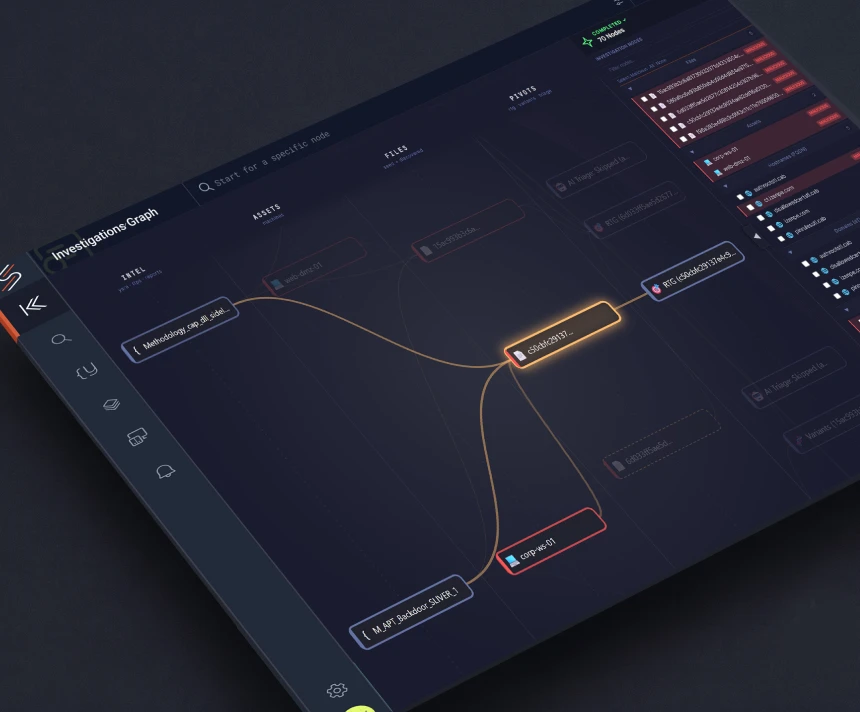
Stairwell’s approach is run to ground: one-click pivots from a single file or IOC into related variants, linked artifacts, and infrastructure.
This is the difference between “we saw something weird” and “we understand the intrusion chain.”
It is also how you make threat intel operational inside the SOC instead of living in a PDF or spreadsheet.
YARA at Ludicrous Speed: Retroactive Forever
Most security teams like YARA, but also avoid using it broadly because it is slow, manual, and expensive to run at scale.
But for enterprise threat hunting, YARA is still one of the cleanest ways to express intent. The key is performance.
A private VirusTotal alternative should let you:
- Write a rule once
- Match it across your entire historical corpus
- Keep matching it as new files arrive
- Do it fast enough to be operational, not academic
This is where Stairwell’s YARA capabilities matter. They are retroactive forever and continuous by default.
Frequently Asked Questions
What is a private VirusTotal alternative?
A private VirusTotal alternative offers similar hash lookup and file analysis capabilities but does not contribute uploaded samples to a public ecosystem. Files remain stored and analyzed within your own environment and are never shared with anyone else.
In practice, a true enterprise solution also provides continuous reanalysis so your historical file inventory benefits from new intelligence over time. It’s not enough to know that a file is bad, you must also know if was ever in your environment and where.
How does Stairwell keep analysis private?
Stairwell uses a Private Vault architecture. Uploaded files and related artifacts are isolated to the customer and are not shared across tenants.
Your malware visibility. Your data. Your control.
Can enterprises still analyze large volumes of files?
Yes. A private enterprise platform is designed to handle large internal file collections. It supports searching, reanalysis, and integration with existing SOC workflows without public exposure.
At enterprise scale, the differentiator is whether the platform can do this continuously without turning every investigation into a manual project.
Is this just another sandbox?
No. Traditional sandboxes focus on detonating files and generating output. A private enterprise platform combines file analysis, threat intelligence, and ongoing re-evaluation in one system.
Stairwell also emphasizes explainable triage: not just “what happened in a detonation,” but “what the file is trying to do.”
Does private malware analysis limit visibility into broader threats?
No. Organizations can still consume external threat intelligence and research.
The difference is that their own files are not exposed in order to gain that context. You can enrich your private corpus with the world’s intel without donating your artifacts to the world.
How does this help prove incident containment?
Containment is not that the “alerts stopped.”
Containment is being able to show evidence that the relevant files, variants, and related artifacts are not present anywhere else in the environment, now or historically.
A continuous, private file corpus lets teams answer that question quickly and defensibly.
The Enterprise Shift in Cyber Threat Intelligence
Security programs are under more scrutiny than ever. Regulators ask questions. Customers ask questions. Leadership asks questions.
In that environment, convenience alone is not enough.
The demand for a VirusTotal alternative for enterprises reflects a practical shift. Teams want fast triage and deep malware analysis, but within a model that respects ownership and control.
They still need hash lookups. They still need context around suspicious files. They still need to connect file intelligence to broader threat hunting efforts.
What changes is the foundation.
Analysis stays inside the organization. Intelligence continues to improve over time. Your historical visibility becomes a competitive advantage.
Private by design. Continuous by default. Upload nothing publicly. Lose nothing historically.
That is not a feature. That is what threat intelligence should have evolved into.