Take a Virtual Tour
 Book a Demo

TL;DR: Most threat intelligence workflows include a hidden trade: you submit a suspicious file, you get a verdict, and the adversary gets a signal. Crowdsourced platforms expose your detection timing, burn your tooling visibility, and feed a development feedback loop that sophisticated threat actors actively monitor.
Worse, the shared corpus those platforms are built on reflects what the crowd has seen, not what has been deployed specifically against you. Targeted tooling, custom implants, and hash-modified variants generate no public matches because they were never submitted by anyone else. The fix isn’t a better crowdsourced feed.
It’s owning your intelligence: a private corpus built around your own environment, continuously reanalyzed as new intelligence emerges, invisible to the adversaries trying to map your detection posture. Your advantage should stay yours.
Table of Contents
- The Trade Nobody Reads Carefully
- What You’re Actually Disclosing
- This Isn’t Theoretical
- The Crowd Isn’t Covering Your Environment Anyway
- The Shift: From Crowdsourced Intelligence to Owned Intelligence
- What This Looks Like in an Actual Investigation
- Stop Renting Someone Else’s Intelligence
- Frequently Asked Questions
The Trade Nobody Reads Carefully
There is a deal at the center of most threat intelligence workflows. You submit a suspicious file to a crowdsourced analysis platform. In seconds, you get a verdict, a list of engine detections, some behavioral notes, maybe a network indicator. The exchange feels one-sided in your favor.
It isn’t.
You gave something far more valuable to every other subscriber on that platform. Including, in some threat models, the adversaries who are actively targeting you.
Crowdsourced threat intel works for one reason: scale. The more samples people upload, the bigger the dataset becomes. That’s great for the crowd. It’s not always great for you.
The problem isn’t the model itself. The problem is that the same architecture that makes the crowd’s intelligence powerful also makes it a structural liability for any organization whose threat model includes sophisticated actors who know exactly how to use public platforms to understand what their targets have and haven’t detected.
Crowdsourced threat intel? We call that giving away your advantage.
What You’re Actually Disclosing
When an analyst submits a malware sample to a public service, the obvious disclosure is the file. The less obvious disclosure is everything the submission signals. Sophisticated threat actors read that signal back in real time:
- Your detection timing. They know when your team found the file, which tells them how long their tooling operated undetected in your environment.
- Which variants are burned. Submissions confirm which versions triggered detection, so operators know exactly what to retool before redeployment.
- Your response posture. A submission without follow-on activity signals an organization still in triage. One with rapid related lookups signals active investigation.
- Your sector’s collective blind spots. Aggregated submission patterns reveal which industries are hunting which threats and which are not.
None of this requires extraordinary capability. It requires only patience and an understanding of how the platform works.
For organizations in regulated sectors, including financial services, healthcare, defense, and energy, the exposure runs deeper still. The file you upload for analysis may not just be malware. It may be a piece of malware that was actively operating inside an environment where the data it touched carries compliance protection. A public upload isn’t just an intelligence leak. It may be a compliance event.
This Isn’t Theoretical
Threat actors monitoring public malware repositories to retool against known detection is not a hypothetical. It has been documented for more than a decade. Submitting modified variants to test which detection engines fire and which don’t is standard practice for criminal and state-sponsored groups alike.
Ransomware operators cycle their encryptors specifically to evade the detections they have watched public platforms assign to earlier versions. The economics of ransomware-as-a-service accelerated this cycle: produce new variants cheaply across affiliate networks, and let public detection platforms tell you exactly when a version has become too visible to deploy.
Every crowdsourced detection that fires on a submitted sample is simultaneously a useful verdict for the defender and a development signal for the attacker. The organizations most exposed to that loop are precisely the ones with the highest stakes: enterprises that are actively targeted, operating in sectors where adversaries are motivated and technically sophisticated.
These are the organizations that most need reliable threat intelligence. And they are the organizations for whom the crowdsourced model creates the most significant operational risk.
The Crowd Isn’t Covering Your Environment Anyway
Even setting aside the disclosure problem, crowdsourced threat intelligence has a structural coverage gap that doesn’t get enough attention.
It reflects what the crowd has seen. Not what has been deployed against you.
Public corpuses are heavily weighted toward widely distributed commodity malware. Samples that arrive in high volume from phishing campaigns, that get submitted by enterprise AV clients across thousands of organizations, those get catalogued quickly and thoroughly.
The threats that concern mature security teams look different. Targeted intrusion campaigns against specific sectors routinely use tooling that has never appeared in any public corpus. Implants built for a single operation, or commodity tools customized before deployment, generate no matches at all, because no one else has seen them. The absence of a verdict is not a clean bill of health.
This is the variant problem in its clearest form. A threat actor who understands your detection posture won’t redeploy the exact sample you already caught. They’ll deliver a structurally related variant with a different hash, no signatures, and no public detection, because it’s never been submitted anywhere before. Point-in-time detection built on crowdsourced verdicts is precisely what this technique is designed to defeat.
Understanding that a new, unrecognized file is related to something you previously investigated, and inherits that threat context, requires analysis that goes beyond what any public crowd has catalogued.
The Shift: From Crowdsourced Intelligence to Owned Intelligence
Most malware intelligence today works like this:
The old model Upload a file. Get a verdict. Share the result with everyone else.
That’s crowdsourced security. Your data powers the crowd. The crowd’s data powers your detection. The adversary monitors both.
Stairwell flips the model.
Instead of contributing to a public corpus, you build your own. Instead of point-in-time lookups, you get continuous hindsight. Instead of verdicts, you get understanding.
The Stairwell model Your files. Your vault. Your malware corpus. Your advantage.
Private by design. Continuous by default.
Private threat intelligence means your file telemetry, your analysis results, and your detection rules exist in an environment adversaries cannot query. Your submissions don’t contribute to a shared pool. Your organization’s detection posture isn’t visible to anyone who pays for the same subscription. What you know stays yours.
Continuous intelligence means the value of the files you collect doesn’t expire the moment the first analysis runs. A binary your EDR flagged three months ago sits in your Private Vault. When a threat research team publishes new campaign attribution next week, that triggers a reanalysis of everything you’ve collected. The file that looked like an unclassified outlier three months ago connects in real time to known threat intelligence, a known campaign, a known infrastructure cluster.
We call this continuous hindsight.
Every file you’ve ever seen is preserved and continuously reanalyzed as new intelligence emerges. The past informs the present. Automatically. Without a single manual action from your team.
What This Looks Like in an Actual Investigation
When an EDR alert fires, a Tier 1 analyst in most organizations runs a hash lookup against a public reputation service. Known-bad hash: escalate. No result: judgment call with almost no information. The no-result scenario is where the real risk lives, because the most targeted threats are exactly the ones that produce no public result.
In a private continuous intelligence model, that same analyst queries Stairwell and gets a materially different answer.
AI Triage steps outside the sandbox. It doesn’t pretend to detonate malware. It reads it.
Structured AI reasoning analyzes the file’s code, behavior, and relationships, explaining what it does and why it exists. Not just a verdict but understanding.
Variant Discovery asks: what else looks like this? It searches your Private Vault and Stairwell’s malware corpus for structurally related files, files that share real DNA with the initial sample, regardless of hash. One confirmed bad file becomes visibility across the entire malware family.
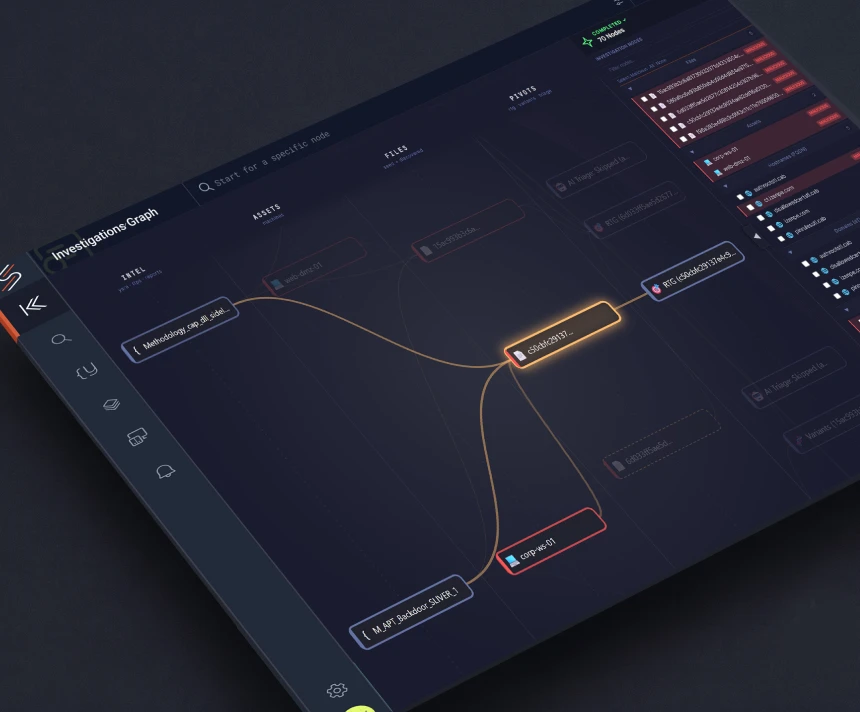
Run to Ground turns one alert into a complete investigation. It maps related files, affected hosts, and associated infrastructure across your organization’s file history, the kind of forensic context that usually takes expensive incident response teams weeks to assemble. In Stairwell, it takes seconds.
The analyst doesn’t need a crowdsourced verdict. They have continuous, explainable analysis built entirely on their own telemetry.
This matters just as much for threat intelligence analysts consuming published reports. When a new threat report documents a campaign targeting your sector, the question isn’t whether those IOCs are generally known. The question is whether they have ever appeared in your specific environment. Stairwell cross-references newly published IOCs against your entire Private Vault automatically, enriched by global intelligence, without exposing your data. Confirmed exposure in seconds. And when nothing matches, you get a documented, defensible confirmation that your environment was clean. Not an uncertain absence of evidence.
Stop Renting Someone Else’s Intelligence
Crowdsourced platforms did enormous good for this industry. They lowered the barrier to malware analysis for teams without dedicated research capability, accelerated collective understanding of common threats, and created shared infrastructure that benefited defenders everywhere. None of that disappears by acknowledging the model has limits.
The limit is sovereignty.
Organizations that route all their file analysis through a shared platform are building their detection capability on intelligence they don’t own, in a corpus they can’t control, accessible to the same adversaries trying to evade their defenses. Renting access to shared intelligence made sense when the alternative was doing nothing. It makes less sense when the alternative is owning a private corpus, built around your own environment, invisible to anyone outside it.
Security is a data problem. Files are truth. And the files your endpoints have seen, when stored, continuously analyzed, and cross-referenced against emerging intelligence, are one of the most accurate pictures of your actual threat surface that exists.
That picture should be yours. Your own VirusTotal, the way it should have evolved.
Stairwell: Private by design. Continuous by default. The way threat intelligence should have evolved.
Frequently Asked Questions
What is crowdsourced threat intelligence and why does it create risk for targeted organizations?
Crowdsourced threat intelligence works by aggregating file submissions, verdicts, and indicators from thousands of organizations into a shared corpus. The more organizations contribute, the more useful the collective dataset becomes. That scale is the model’s strength and its structural liability. When your analysts submit files to a shared platform, they are not just querying intelligence.
They are contributing to it, and everything about that submission, the file itself, the timing, the follow-on activity, is visible to platform operators and in some architectures to other subscribers. For organizations facing sophisticated, targeted adversaries, that visibility is not a feature. It is an exposure.
How do threat actors use crowdsourced platforms against defenders?
Sophisticated threat actors actively monitor public malware analysis platforms to track which of their tooling has been detected. A submission from your environment tells them when their implant was found, how long it operated before detection, and which detection engines responded.
They use that signal to retool before redeployment, submitting modified variants of their own malware to observe which engines fire and which don’t. Ransomware operators do this systematically, cycling encryptors specifically to evade detections they have watched public platforms assign to earlier versions. Every crowdsourced detection that fires on a submitted sample is simultaneously a verdict for the defender and a development signal for the attacker.
Why doesn’t a crowdsourced verdict of “unknown” mean a file is safe?
A no-result from a shared reputation platform means the crowd has not seen that file. For targeted campaigns, that is exactly what you should expect. Intrusion operators routinely use tooling that has never appeared in any public corpus, implants built for a single operation, commodity tools customized before deployment, or hash-modified variants of known malware.
These files generate no matches because no one else has submitted them. The absence of a verdict is not a clean bill of health. It is a gap in coverage that sophisticated adversaries specifically engineer their tradecraft to exploit.
What is the variant problem and why does it matter for detection?
A threat actor who understands your detection posture will not redeploy the exact sample you already caught. They will deliver a structurally related variant with a different hash, no signatures, and no public detection record. Point-in-time detection built on crowdsourced verdicts is precisely what this technique is designed to defeat.
Understanding that a new, unrecognized file is related to something your environment has previously seen, and inherits that threat context, requires analysis that goes beyond what any public crowd has catalogued. Variant Discovery addresses this by identifying structural relationships between files regardless of hash or signature, so one confirmed bad file becomes visible across the entire malware family.
What does “continuous hindsight” mean and how does it change a SOC investigation?
Continuous hindsight means that every file your organization has ever collected stays active in your corpus and is continuously reanalyzed as new intelligence emerges. When a threat research team publishes new campaign attribution, when a new malware family gets documented, when a published IOC surfaces a connection to something in your Private Vault, that link is made automatically, without a manual search, without an analyst knowing to look for it.
In a practical SOC workflow, this means the file your EDR flagged three months ago can surface a confirmed connection to a known piece of threat intelligence today, the moment new intelligence makes that connection visible. The investigation starts with context rather than from zero.
How does AI Triage differ from traditional sandbox analysis?
Traditional sandbox analysis attempts to detonate a file in a controlled environment and observe its behavior at runtime. AI Triage takes a different approach. It steps outside the sandbox. It doesn’t pretend to detonate malware. It reads it.
Structured AI reasoning analyzes the file’s code, behavior, and relationships, explaining what it does, how it works, and why it exists. The result is not a verdict. It is understanding, explainable analysis that gives analysts the context they need to make decisions, regardless of whether the file has ever been seen by a public platform.
What is the difference between owned intelligence and rented intelligence?
Rented intelligence means paying for access to verdicts derived from a shared corpus that belongs to a platform operator. Your data contributes to the pool, the platform retains and reanalyzes it, other subscribers benefit from it, and your subscription grants you access to what the collective has seen.
Owned intelligence means your files go into a Private Vault that you control, analyzed against your own telemetry, with no external visibility into your detection activity. The intelligence derived from your environment belongs to your organization. Your detection posture is not visible to platform operators, other subscribers, or the adversaries who monitor public submission streams. What you know stays yours.
When does it make sense to move away from crowdsourced threat intelligence?
The crowdsourced model works well for organizations whose primary threat is commodity malware distributed at scale, where the crowd’s collective visibility meaningfully covers the threats targeting their environment.
It becomes a structural liability when adversaries are sophisticated enough to monitor public platforms for retooling signals, when targeted tooling is customized specifically to evade public detection, when compliance requirements restrict what files can be uploaded to shared platforms, or when the organization needs retroactive visibility across its own file history rather than verdicts on what the crowd has seen.
The question is not whether crowdsourced platforms have value. It is whether the trade, your data for shared verdicts, still reflects what your threat model actually requires.