Take a Virtual Tour
 Book a Demo

Ransomware is often treated like a moment-in-time crisis: systems lock up, operations stop, and the organization moves into emergency response. But by the time files are encrypted, the attack has usually been underway for days, weeks, or longer.
Modern ransomware operations often include phishing, exploitation, credential theft, remote access, malware staging, lateral movement, data theft, and only then encryption or extortion. Stairwell’s own ransomware research has shown this pattern in the wild. In its Akira research, Stairwell observed attacker tradecraft leading up to ransomware deployment and helped notify multiple companies between the point of data exfiltration and public listing on Akira’s data leak site.
That is the opportunity defenders need to focus on: the time before ransomware becomes visible.
Ransomware prevention is not only about stopping the final payload. It is about finding the earlier signs, preserving the evidence, validating intelligence against your own environment, and proving whether you are truly clear.
Here are five ways to think about ransomware defense before an attack reaches the point of encryption.
Table of Contents
- Treat ransomware as a campaign, not a single file
- Preserve the files attackers leave behind
- Validate threat reports against your own environment
- Re-analyze old files with new intelligence
- Prove containment before declaring victory
- Ransomware prevention starts before encryption
1. Treat ransomware as a campaign, not a single file
Many ransomware incidents are not caused by one obvious malicious executable. They involve a chain of tools, scripts, loaders, credentials, infrastructure, and related malware. A single hash or alert is rarely the whole story.
That is why defenders should ask broader questions:
- Is this file bad?
- Where else has it appeared?
- Are there related variants?
- Was it repacked?
- Did we get everything?
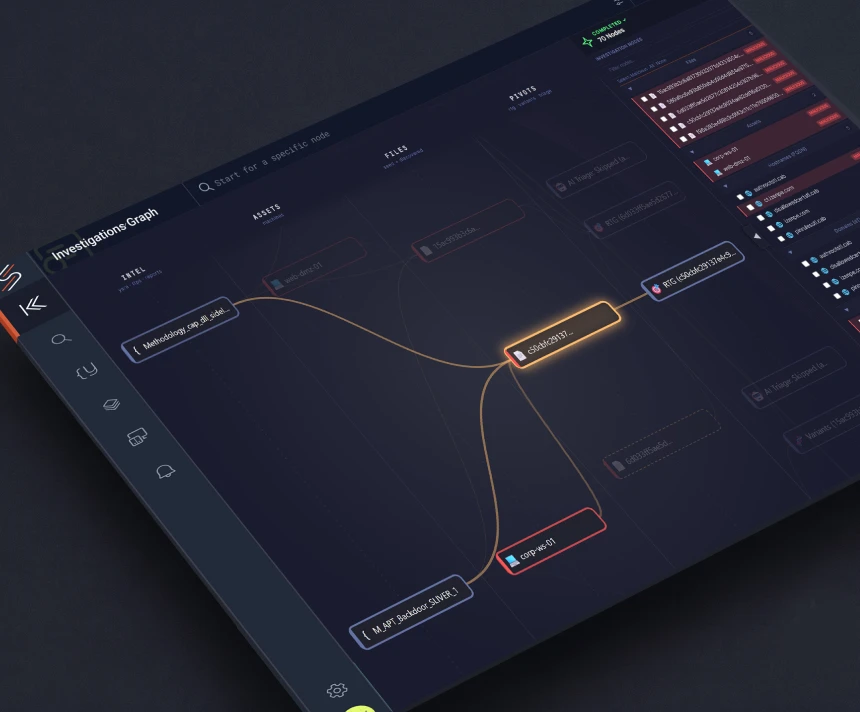
Those are the questions Stairwell is built to help answer. Stairwell focuses its workflow around moving from a single alert or IOC to a broader constellation of connected threats, using techniques such as AI triage, Variant Discovery, Run-to-Ground, Threat Reports, and File Connections.
This matters because ransomware affiliates frequently adapt their tooling. If defenders only search for one known indicator, they may miss related samples already present in the environment.
What to do now: Build your ransomware process around relationships, not just indicators. When you find one suspicious file, immediately look for variants, related infrastructure, similar files, and historical appearances across your environment.
Additional resource: Read Stairwell’s technical ransomware research on Akira and Kuiper to see how ransomware operations use supporting infrastructure and tooling before public impact.
2. Preserve the files attackers leave behind
Most security programs are built around logs and alerts. Those are valuable, but they are also incomplete, filtered, normalized, and often limited by retention windows. Ransomware investigations frequently run into the same painful question: do we still have the evidence?
Stairwell’s point of view is that files are one of the most important sources of ground truth. Stairwell is a threat intelligence platform that continuously detects malware campaigns, indicators of compromise, and vulnerable files across the enterprise. The platform emphasizes privacy, unlimited retention; continuous re-analysis; and understands that enterprise files are the dataset that sets Stairwell apart from log-centric approaches.
For ransomware prevention, this changes the timeline. Instead of only asking what is happening now, defenders can ask what has ever appeared in their environment.
What to do now: Make file preservation part of your ransomware readiness plan. Ensure your team can search historically for suspicious files, malware families, YARA matches, and IOCs from new threat reports.
Additional resource: Review Stairwell’s resources hub for more on how Stairwell approaches threat intelligence, malware analysis, YARA rules, and detection.
3. Validate threat reports against your own environment
Threat reports are useful, but they are not the same thing as actionable intelligence. A report about a ransomware campaign becomes much more valuable when you can answer: Did any of these indicators appear in our environment?
Stairwell makes this distinction clearly: a threat report is background reading, while actionable threat intelligence comes from connecting the report’s indicators to your specific environment. For example, knowing that hashes from a ransomware report appeared on your endpoints is something a security team can act on immediately.
This is especially important for ransomware because public reporting often includes Indicators of compromise (IOCs), YARA rules, malware family names, infrastructure, and TTPs. But many teams still manually copy indicators between tools, search across incomplete logs, and hope the data is still available.
What to do now: When a new ransomware report is published, do not stop at reading it. Extract the indicators, search them against your environment, identify affected assets, and document whether the result is “found” or “all clear.”
Additional resource: Stairwell’s Threat Reports capability explains the difference between simply consuming reports and turning them into environment-specific intelligence.
4. Re-analyze old files with new intelligence
Ransomware defense is not static. A file that was unknown or low-confidence last month may become clearly malicious once new intelligence, YARA rules, malware research, or related samples emerge.
This is why continuous re-analysis is so important. Stairwell continuously detects across enterprise files, and also allows for re-analyzing of every file, correlating against the latest threat intelligence, and flagging new matches that would have been missed previously.
That gives security teams the ability to benefit from hindsight. When new ransomware intelligence appears, they can look backward across retained files and ask whether early-stage tooling was already present.
What to do now: Create a repeatable process for applying new ransomware intelligence to historical files, not just live alerts. This includes new YARA rules, published IOCs, suspicious filenames, malware family relationships, and related samples.
Additional resource: Read Stairwell’s work on Variant Discovery, which describes using deep learning to uncover unknown related malware, including ransomware, remote access trojans, and other crimeware.
5. Prove containment before declaring victory
One of the hardest parts of ransomware response is knowing whether the environment is truly clean. Removing one payload is not enough if related tools, staged files, or variants remain elsewhere.
This is where many teams get stuck in fragmented workflows. They pivot from EDR to SIEM, to reputation tools, to sandboxes, to TIPs, to endpoint access, and then back to logs. Stairwell’s workflow framing calls out this pain directly: teams are trying to answer whether a file is bad, where else it exists, and whether they got everything, while dealing with incomplete logs and multi-tool investigation loops.
Before ransomware detonates, those delays matter. After an incident, they matter even more. The goal is not just to respond quickly; it is to reach verified closure.
What to do now: Define what “contained” means before the incident. Your ransomware playbook should require evidence that related files, variants, and indicators have been searched across the environment, not just that the original alert was remediated.
Additional resource: Stairwell’s blog includes a related piece on how to prove incident containment and “evidence of absence” for incident response and board-level reporting.
Ransomware prevention starts before encryption
The best time to stop ransomware is before the ransom note appears.
That requires a shift in mindset. Instead of treating ransomware as a single payload, defenders should treat it as a campaign with artifacts, relationships, variants, and historical traces. They need to preserve evidence, continuously re-analyze files, validate threat intelligence against their own environment, and prove containment with confidence.
Stairwell helps security teams do exactly that by connecting threat intelligence to the files and indicators that actually exist inside their enterprise. It brings together file preservation, continuous detection, variant discovery, threat report validation, investigation workflows, and response-ready reporting so teams can find threats before attackers reach their objective.
Continue learning:
- Explore Stairwell’s threat intelligence resources, malware analysis reports, YARA rules, and ransomware research.
- Read Stairwell’s Akira ransomware research.
- Read Stairwell’s Kuiper ransomware technical report.
- Read Stairwell’s Black Basta overview.
- Read Stairwell’s Yurei detection YARA rule.
- Learn how Stairwell turns threat reports into actionable intelligence.
- See why Stairwell focuses on continuous malware detection across enterprise files.a